
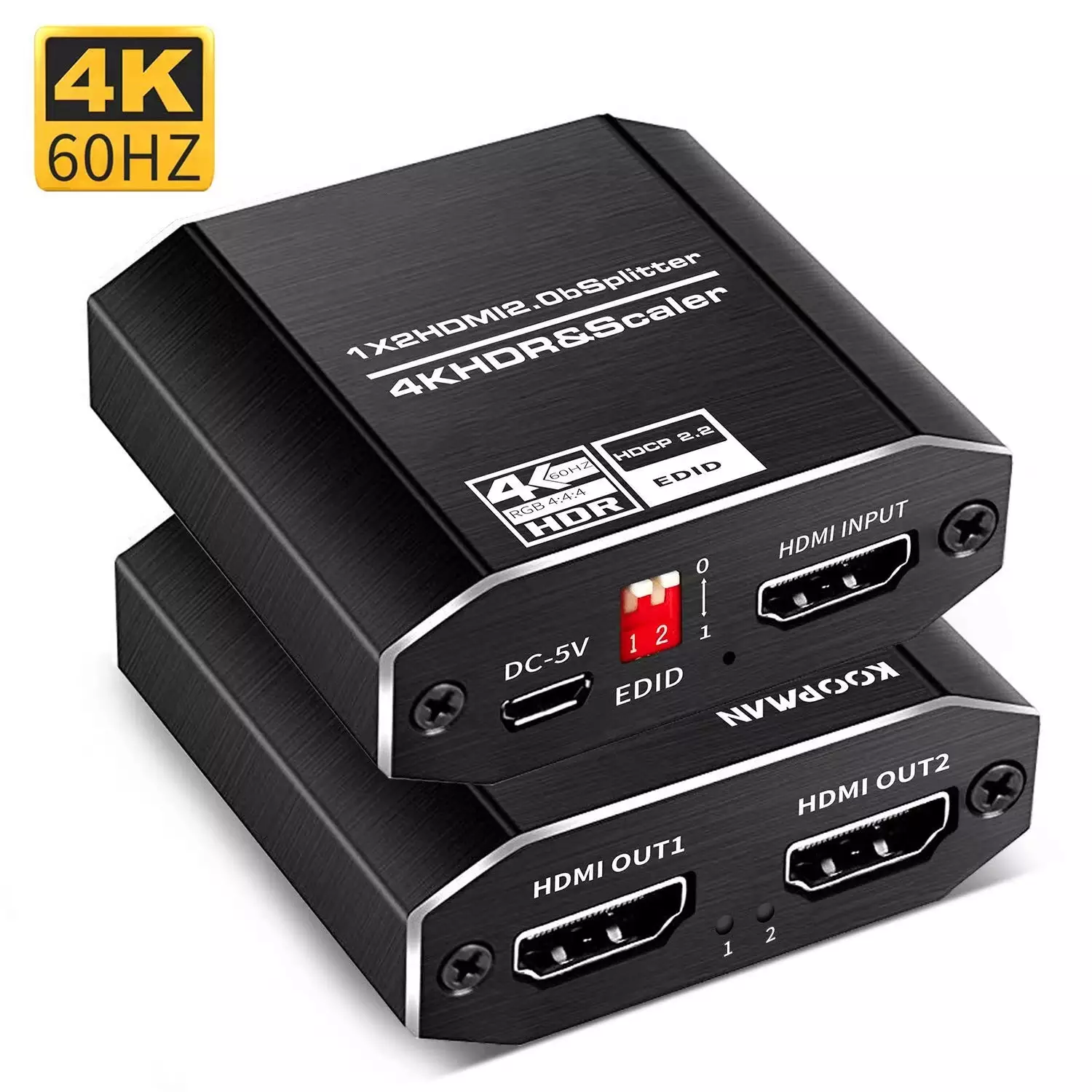
1×2 HDMI v2.0b Splitter & Scaler with HDR | 4k Ultra HD 60hz | FullHD 1080p 120Hz & EDID Support
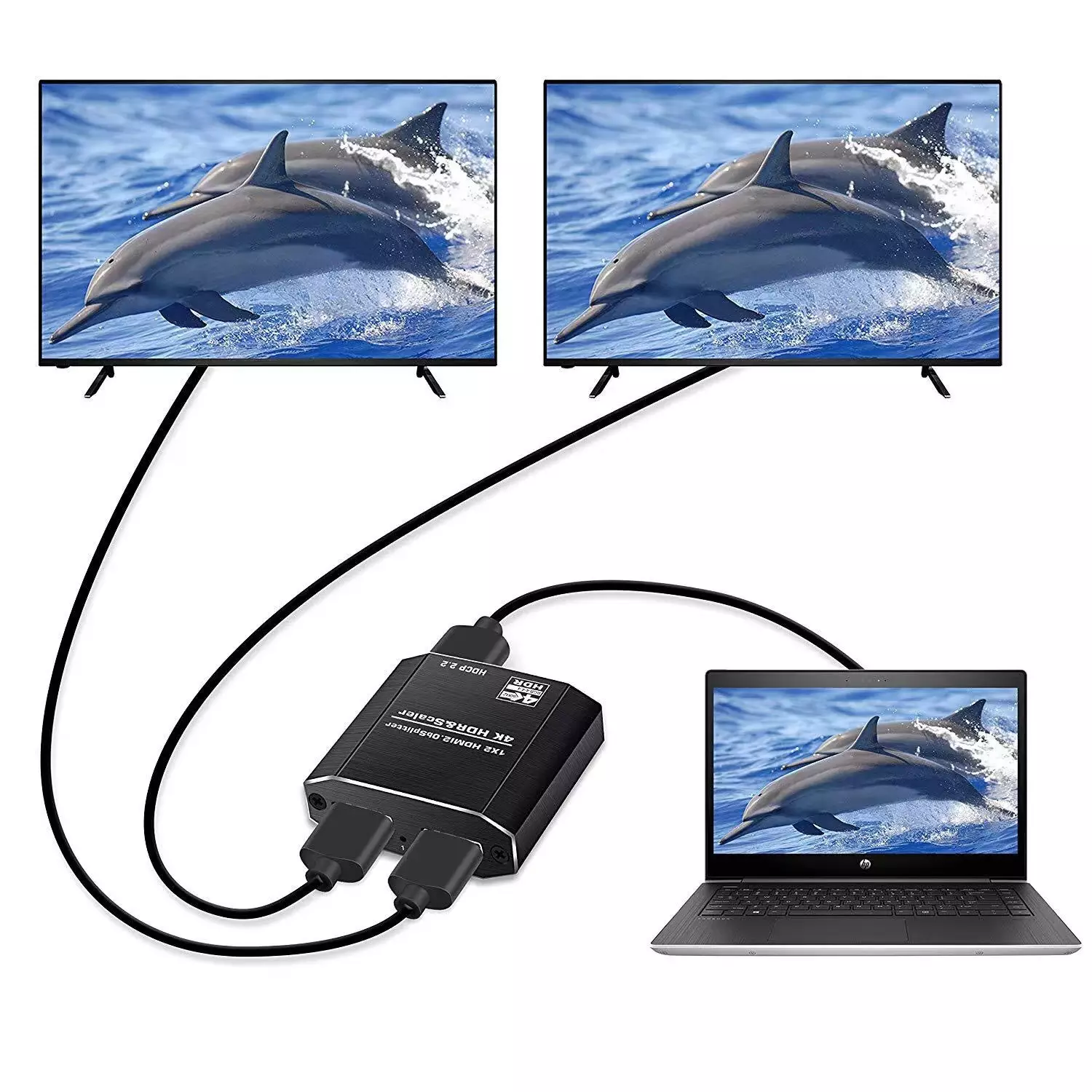
The Ultra HD 1×2 HDMI Splitter uses a single HDMI source, splitting to multiple HDMI displays/screens. The Splitter allows one HDMI devices to be split into two HDMI compatible monitors or projectors. The Splitter can also be placed at the end of a long HDMI cable to regenerate the HDMI signal.
This splitter supports the refresh rates and color spaces below for 4K IF supported by both the display and the source/player/PC
- 4k (3840 x 2160) 60hz YCbCr 4:4:4 8-Bit, YCbCr 4:2:2 12-Bit, YCbCr 4:2:0 12Bit, YCbCr 4:2:0 10 Bit & HDR, HDR10 & HDR10Plus
- 4k (3840 x 2160) 144/240hz YCbCr 4:2:2 10-Bit, YCbCr 4:2:0 12Bit, YCbCr 4:2:0 10Bit & HDR, HDR10 & HDR10Plus
YCbCr 4:2:2 12-bit is better than YCbCr 4:2:0 10-bit because it offers superior color detail (higher chroma resolution with 4:2:2) and a wider range of shades, reducing banding and providing smoother gradients, especially for HDR content and professional work
- 4:4:4 vs 4:2:2 vs 4:2:0 (Chroma Subsampling):
- 4:4:4 (No Subsampling): Full color for every pixel.
- 4:2:2: Half the horizontal color information (chroma) of 4:4:4 (2 color samples for every 4 luminance samples).
- 4:2:0: Quarter the color information (chroma) of 4:4:4 (2 color samples for every 4 pixels in a 2×2 block).
- Benefit: 4:2:2 retains more color detail than 4:2:0, meaning less color blurring or artifacting, especially around edges and text.
- 12-bit vs 10-bit vs 8-bit (Bit Depth):
- Bit Depth: Determines the number of distinct color shades available for each primary color (Red, Green, Blue).
- 8-bit: 256 shades per channel (around 16.7 Million colors).
- 10-bit: 1,024 shades per channel (over 1 billion colors).
- 12-bit: 4,096 shades per channel (over 68 billion colors).
- Benefit: Higher bit depth (12-bit) provides significantly more steps between colors, preventing “color banding” (visible steps in smooth gradients) and creating smoother, more realistic images, crucial for HDR, HDR10 and HDR10Plus
Please note this product is supplied with a USB Power cable (Either Micro USB or USB C Depending on what the device requires) and does NOT INCLUDE A 220v to USB Wall Socket Power adapter. The unit must be powered from a nearby USB Port on a HDTV/Projector/Digital Receiver or alternatively a 220v Wall Adapter to 5v USB Charger/Power supply similar to Slimline 5 Volt 2 Amp USB Wall Charger/Power Supply
How to use an HDMI Splitter to Split Video Signals to Multiple Displays / HDTV’s Wiring
Features
- Distribute 1 HDMI input signal to 2 channels of the same HDMI output to displays
- Support UHD 4KX2K up to 60Hz, 1080p / 1920 x 1080 up to 120hz Support
- Support 3D: If both HDMI signal sources and HDMI displays support 3D, this product will automatically recognize and output 3D video
- Supported Audio: Support Standard Audio, DSD Audio and HD Audio Support
- Supports the latest HDMI2.0b specification, backwards compatible with HDMI1.0, HDMI1.4
- Supports HDCP version: HDCP 2.2 backwards compatible with HDCP1.4
- Supported video resolution: 480i/480p/756i/756p/720p/1080i/1080p/4Kx2K at up to 60Hz
| EDID MODE Switches – 0 is up 1 is down | ||
| 0 | 0 | EDID Intersection of HDMI 1 and 2 port |
| 0 | 1 | EDID of HDMI 1 port |
| 1 | 0 | 4K 60Hz of HDMI 1 port , 1080p of HDMI 2 ports |
| 1 | 1 | 4K 60Hz of HDMI 1 and 2 port |
How to use an HDMI Splitter to Split Video Signals to Multiple Displays / HDTV’s Instructional Video and Wiring
The HDMI Cables below are commonly used with the splitter:
40 Meter Fiber HDMI Cable 18Gbps | 4k HDMI v2.0 Cable Male to Male | Premium High Speed
1.8 Meter micro HDMI (Type D) to Standard HDMI Cable 4k Ultra HD – Raspberry PI HDMI Cable


Reviews
There are no reviews yet.