
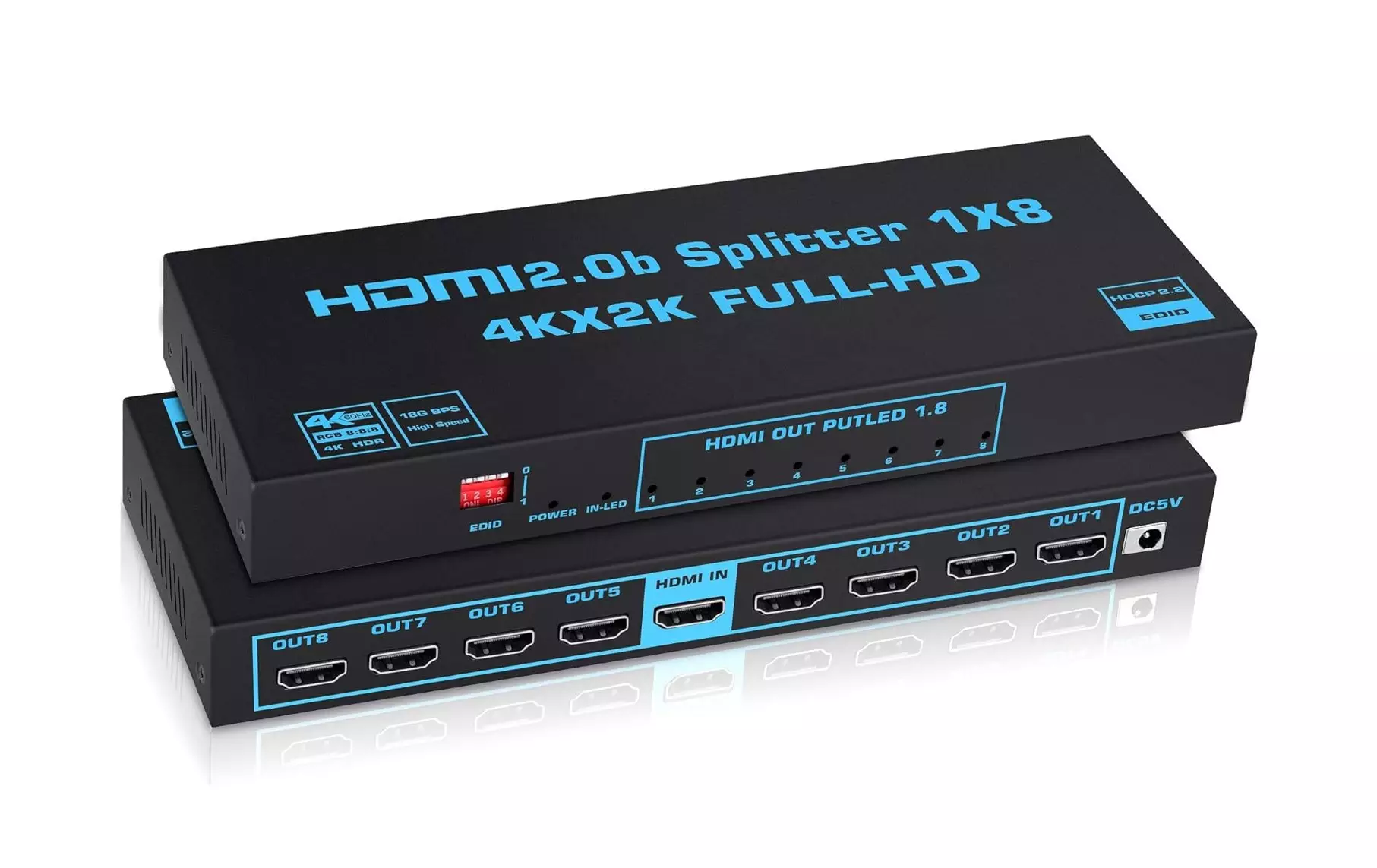
1×8 HDMI v2.0b Splitter with HDR | 4k Ultra HD 60hz, FullHD 165Hz & EDID Support
The UltraHD 1×8 HDMI Splitter uses a single HDMI source, splitting to multiple HDMI displays/screens. The Splitter allows one HDMI devices to be split into eight HDMI compatible monitors or projectors. The Splitter can also be placed at the end of a long HDMI cable to regenerate the HDMI signal.
Features
- Distribute 1 HDMI input signal to 8 channels of the same HDMI output to displays
- Support UHD 4KX2K@60Hz, not only 4Kx2k@24/25/30Hz
- Support 3D: If both HDMI signal sources and HDMI displays support 3D, this product will automatically recognize and output 3D video
- Supported Audio: Support Standard Audio, DSD Audio and HD Audio Support
- Supports the latest HDMI2.0b specification, backwards compatible with HDMI1.0, HDMI1.4
- Supports HDCP version: HDCP 2.2 backwards compatible with HDCP1.4
- Supported video resolution: 480i/480p/756i/756p/720p/1080i/1080p/4Kx2K at up to 60Hz
This splitter supports the refresh rates and color spaces below for 4K IF supported by both the display and the source/player/PC
- 4k (3840 x 2160) 60hz YCbCr 4:4:4 8-Bit, YCbCr 4:2:2 12-Bit, YCbCr 4:2:0 12Bit, YCbCr 4:2:0 10 Bit & HDR, HDR10 & HDR10Plus
- 4k (3840 x 2160) 144/240hz YCbCr 4:2:2 10-Bit, YCbCr 4:2:0 12Bit, YCbCr 4:2:0 10Bit & HDR, HDR10 & HDR10Plus
YCbCr 4:2:2 12-bit is better than YCbCr 4:2:0 10-bit because it offers superior color detail (higher chroma resolution with 4:2:2) and a wider range of shades, reducing banding and providing smoother gradients, especially for HDR content and professional work
- 4:4:4 vs 4:2:2 vs 4:2:0 (Chroma Subsampling):
- 4:4:4 (No Subsampling): Full color for every pixel.
- 4:2:2: Half the horizontal color information (chroma) of 4:4:4 (2 color samples for every 4 luminance samples).
- 4:2:0: Quarter the color information (chroma) of 4:4:4 (2 color samples for every 4 pixels in a 2×2 block).
- Benefit: 4:2:2 retains more color detail than 4:2:0, meaning less color blurring or artifacting, especially around edges and text.
- 12-bit vs 10-bit vs 8-bit (Bit Depth):
- Bit Depth: Determines the number of distinct color shades available for each primary color (Red, Green, Blue).
- 8-bit: 256 shades per channel (around 16.7 Million colors).
- 10-bit: 1,024 shades per channel (over 1 billion colors).
- 12-bit: 4,096 shades per channel (over 68 billion colors).
- Benefit: Higher bit depth (12-bit) provides significantly more steps between colors, preventing “color banding” (visible steps in smooth gradients) and creating smoother, more realistic images, crucial for HDR, HDR10 and HDR10Plus
| EDID MODE Switches – 0 is up 1 is down | ||
| 0 | 0 | EDID Intersection of HDMI 1 and 8 port |
| 0 | 1 | EDID of HDMI 1 port |
| 1 | 0 | 4K 60Hz of HDMI 1 port , 1080p of HDMI 8 ports |
| 1 | 1 | 4K 60Hz of HDMI 1 and 8 port |
How to use an HDMI Splitter to Split Video Signals to Multiple Displays / HDTV’s Instructional Video and Wiring
The HDMI Cables below are commonly used with the splitter:
40 Meter Fiber HDMI Cable 18Gbps | 4k HDMI v2.0 Cable Male to Male | Premium High Speed


Reviews
There are no reviews yet.